How to Prepare a Virtual Presentation People Remember
Aug 30, 2023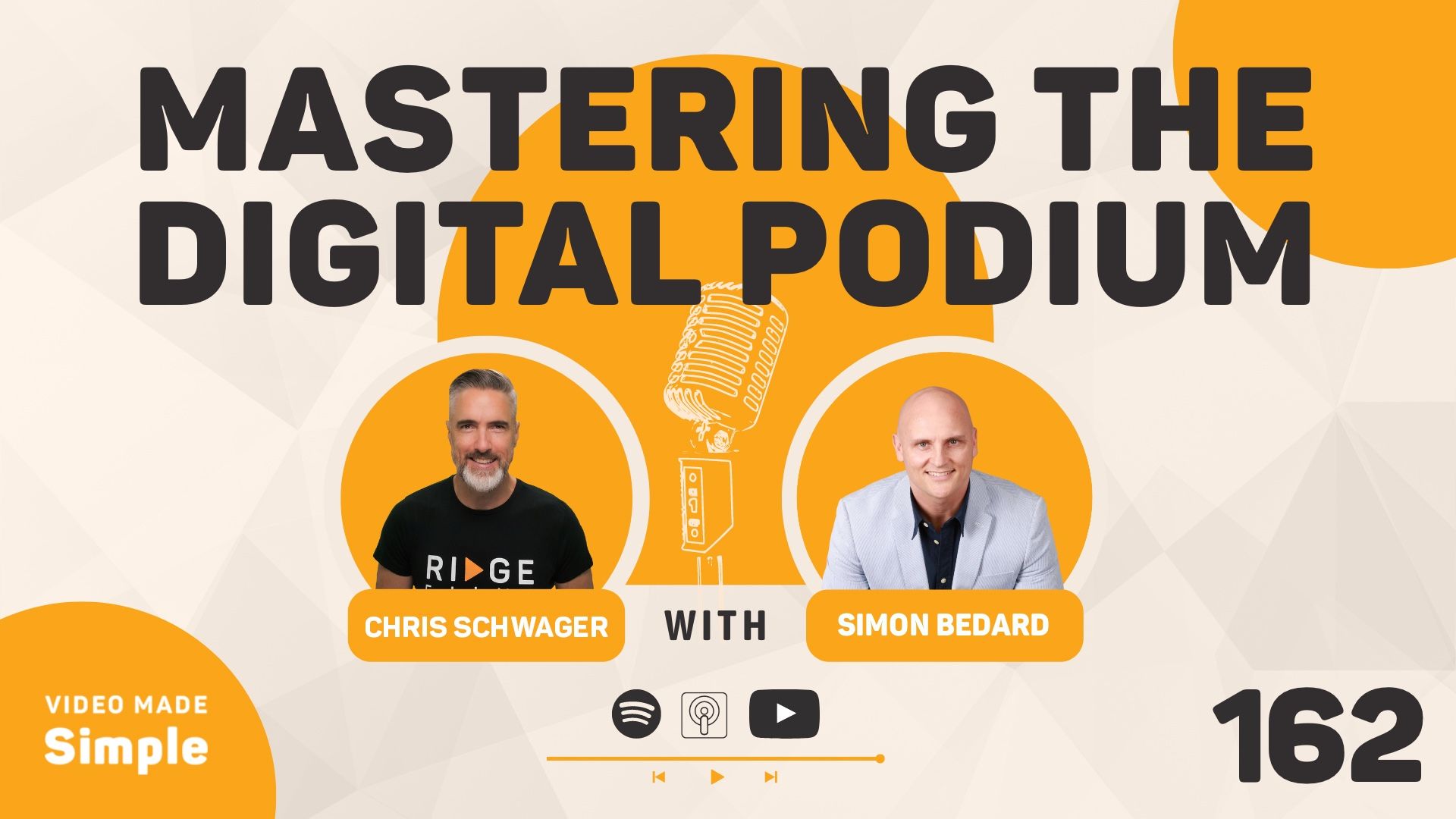
To prepare a virtual presentation people remember, build it around one controlling idea and a real client story, open with what the audience will get, keep each slide to a few words, and record with the camera at eye level in a quiet, controlled room. Above all, be yourself: you know your topic better than anyone watching.
Key takeaways
- Start with what the audience will take away; your title and company matter far less to them.
- A single controlling idea and a clear structure tell viewers you are in control of the material.
- A real story, even one you think is ordinary, holds attention better than statistics.
- Use slides sparingly: more than a couple of words and people stop reading, and busy charts are lost on a small screen.
- A phone at eye level usually looks better than a laptop webcam, and a closed, quiet room fixes most sound and light problems.
This page draws on a 2023 episode of Ridge Films' podcast, recorded while Chris Schwager and Simon Bedard, founder and CEO of Exit Advisory Group, were preparing speakers for an online business summit. The questions Simon asked are the ones most people have before presenting on a screen.
What should you say first in a virtual presentation?
What the audience will get from you. Chris's advice for the short intro clips speakers recorded before the summit applies to the opening of any talk:
"This is not about you. Uh, it's, it's all about what's gonna, what they're gonna take away from this presentation, right." Chris Schwager
Your name is a courtesy worth giving. Your job title and company usually aren't, unless your brand is already well known to that audience. Get to the point: what you'll talk about and why it is useful to them. Simon's own example was a single line inviting people to join him for his top three tips on maximising the value of their company. Casual, conversational and quick.
How should you structure a virtual presentation?
Around one idea, with a clear shape. Chris rates this above everything else in preparation:
"I think a controlling idea is one of the most underestimated areas of presentation creation. And secondly is structure. People expect structure." Chris Schwager
Structure tells the audience you are in control of the information and that they will get what they came for. A simple way to build it:
- Pick the controlling idea. Brainstorm what your audience finds interesting, then test a short list on a couple of colleagues.
- Back it with a customer story. What happened, what you did and how it turned out. A story you think is ordinary is a new perspective for the person hearing it.
- Write the flow before the slides. Chris's warning was that building the slide deck first and working backwards is the worst way to do it. Get the argument flowing from one point to the next, then add slides.
- Give every slide a takeaway. If you can't say what the audience gains from a slide, cut it.
- Go easy on jokes. Humour can land differently on a screen than you expect.
Simon showed how much a story changes a dry subject. A talk about tax sends people to the window, he said, but open with a story, in his example a couple who sold their business and spent a million dollars more than they needed to, and people are on the edge of their seat. More ideas in tips to ace your online live event presentations.
How much text should your slides have?
Very little. Chris's rule:
"I just realize if you've got more than a couple of words, people are not going to read it. Don't waste your time on it." Chris Schwager
On a virtual stage, fine detail is lost, so simplify any busy graph or chart until it reads on a small window. Slides are there to support the conversation. For a 10 or 20-minute talk, keep them to the bare essentials and let your face do the work.
Should you present from a phone or a laptop?
For many people a phone is the better camera. Laptop webcams are often low resolution and sit low on the desk, so they look up your nose. If you use a phone:
- Put it at eye level. That is the best spot for the camera, with a little space above your head rather than a lot.
- Keep it steady. A small tripod helps. Holding the phone is fine too, and keeps the microphone close, which usually sounds better.
- Don't stand too far back. Without an external microphone, distance from the phone makes you sound echoey.
- Control the room. Close the blinds, shut out noise, and move clutter out of shot.
The aim is to remove the variables that get in the way, so you can focus on what you're saying. For recurring webinars and online talks, our guide to webinars on video goes further.
Should you script a virtual presentation?
For a short intro or promo clip, no. Chris's view was that business owners can talk without a script and should keep it loose, then release it. For the main talk, structure it carefully but don't over-rehearse it into something stale. Simon's reminder to every speaker was the right frame:
"You're coming onto this event because you are an expert in your field. You've got value to add to business owners, so don't overthink the production of all this." Simon Bedard
Chris added that you have a forgiving audience, and real power: nobody knows as much about your topic as you do. If reading or remembering is what trips you up, webinar presentation tips covers delivery.
What should you do with the recording afterwards?
Use it again. A presentation you worked hard on shouldn't play once. Cut short pieces from it for social media and your website, so one recording keeps working long after the event. Chris calls it a shoot-once, distribute-many model. How to repurpose videos for more reach shows how.
Virtual presentation questions we get asked
How do I make a virtual presentation engaging?
Build it around one controlling idea, open with what the audience will get, tell a real client story, and keep slides to a few words. Present with your camera at eye level in a quiet room so your face carries the talk.
Is a phone or a laptop webcam better for presenting online?
Often a phone. Most laptop webcams are low resolution and sit too low. A phone at eye level on a small tripod, close enough for clear sound, usually looks and sounds better.
How many words should be on a presentation slide?
As few as possible. If a slide has more than a couple of words, most people won't read it, and detailed charts are lost on a small screen. Use slides to support what you say.
Should I use a script for a virtual presentation?
Not for a short intro or promo clip, where a casual, conversational approach works best. For a longer talk, plan the structure and the story carefully, but avoid over-scripting it into something stale.
Want help before your next talk?
If you present online regularly, a setup that is always ready and some coaching on delivery make every talk easier. We install a studio at your desk and coach what you say and how you come across on screen. Book a call and tell us what's coming up.
Episode transcript
Read the full transcript
Simon Bedard:
You're coming onto this event because you are an expert in your field. You've got value to add to business owners, so don't overthink the production of all this. Just be yourself, right? Just be yourself and remember that who you're talking to in the room, that you're trying to just add as much value as you can to them.
[00:00:16] Chris Schwager: Nobody knows as much about your topic as you do, so you have great power. You have the ability to settle into this really nice and be an authority with very little effort.
[00:00:27] Good day. I'm Chris Schwager and this is the Video Made Simple podcast. What you've just heard is a snippet from my chat with Simon Bedard at the 2023 Buy Grow Sell Summit coming up in September. Today we're turning that insightful conversation into a special episode right here. We're diving into how you can create compelling videos that resonate with your audience and drive results. Whether you are new to video or refining a strategy, get ready. We've unveiled some secrets to make videos work for you. Let's jump in.
[00:01:06] Simon Bedard: Can our partners use their smartphone? And is there a difference from your perspective between an iPhone or a whatever, if they were gonna use it, how would they use that?
[00:01:15] Chris Schwager: And it's a great topic because a lot of people think that the iPhone is inadequate. And in fact, it's actually a lot better in most cases than a laptop. Webcam. The tech is just better in an iPhone. Now, I would say that there is pros and cons to both, but often when people set up their laptop, it's low. It kind of shoots up their nose because it's sitting on the desk and not up high. And the quality, as you said, is seven 20 p in lots of cases. The resolution's crappy. It is just like Barbie cam, right? It's not very good at all. So what we do is swiftly get them to change over to their iPhone. Now the iPhone has the mobility, but again, you need to kind of position it and have it in the right spot. So it works, I think for this particular scenario. Having an iPhone in your hand to actually record your bit is not a bad thing.
[00:02:04] If you are getting the best quality sound and the best quality picture, and of course your presentation and what you're saying is coming out the right way, the important thing with any shooting environment is to try and minimize the variables that can get in the way of you doing what you need to do and get you back to your job.
[00:02:21] Right? So lighting is a big thing. Sound is a big thing. So you wanna block all of that out. Close the blinds. Get in a controlled environment where you can just focus on what you need to say and get back to your desk and get on with your job. So we will help you through that process. It's not like you've gotta try and figure it out for yourself. It's a very quick situation where we'll take one, look at you when we're setting up, when we're in our initial video call and we'll go, okay, great. Your background's almost there. Can you just move that pop plant and that archive box out of the way? Just. Tilt the camera slightly up. Uh, yep. That's good. Great. Now let's focus on recording the content. Now, anything that you can do as the presenter for this, to prepare for that, we'll streamline our time together.
[00:03:09] Simon Bedard: When they're getting set up, let's say they're using an iPhone, I imagine angle or height of the phone and stuff like is gonna be real. Like, are they better to have it square on? Are they better to have it a bit above down pointing down? Like what's, what is the ideal for most scenarios.
[00:03:24] Chris Schwager: Right at your eye line? Okay, so at the height of your eyes is the best spot for your camera, so you can have it up and just basically shooting. A lot of people are confused about framing. I'm not gonna bamboozle with you with that, but don't be doing something like this all the way where you've got all this headroom. Right? Allow yourself just a nice, safe zone, and I'm sure I'll be able to tweak that when we meet.
[00:03:46] Simon Bedard: So if somebody's got a like a little tripod thingy or whatever, they can set their iPhone, I'll at least that keeps it stable and you can control it, right?
[00:03:53] Chris Schwager: Yeah, that'll be great. Again, as I say, I'm not opposed to somebody handholding their phone because it's actually for audio, it's, it's a good idea because your proximity to the pickup of the microphone is that much closer. You're almost guaranteed to get better quality audio. A lot of people make the mistake of going, okay, I'll need it kind of set up far away so it gets everything in the frame. But then because they don't have an external microphone, they run the risk of it being very echoey because they're a lot further away from the microphone pickup.
[00:04:22] Simon Bedard: What, what are your views with this sort of initial stuff? Obviously we're gonna ask everyone to do a quick 30-second intro video, and there's then we're going to, Sort of do what we're loosely calling a promo video, but really where they're just answering a question and giving a little bit of advice to the audience, you know, that'll be branded for them. Script or no scripts. What, what's your view with that sort of, with those sort of shorter clips like that?
[00:04:43] Chris Schwager: I think you can afford, as the business owner to go no script and, and just to give it a bit of understanding of what is in it for them. This is not about you. Uh, it's, it's all about what's gonna, what they're gonna take away from this presentation, right. From your presentation. Yeah. So give them the carrot that is going to entice them to your show, right? And so just consider that. So your name, position, company may not be relevant if you don't have a lot of brand value in the market, nobody gives a shit. Right? So just get to the point. What are you going to talk about? Why is that valuable to your audience?
[00:05:19] Simon Bedard: So, so as an, as a working example here, and I'm making this up as I go, but you know, it might be, hi, my name is Simon Bedard. Um, Join me at the Buy Grow Sell Summit 2023, where I'm gonna share, share my top three tips on how to maximize the value of your company.
[00:05:33] Chris Schwager: Correct? A hundred percent. Really casual, really easy to listen to. You don't need, it's not a huge branding exercise. You don't need to give 'em your position and your company and all that. A courtesy of saying your name is great. Keep it casual, keep it conversational, keep it loose. Don't overthink it. Just get it out and. Boom, you know, release it to the world.
[00:05:55] Simon Bedard: If we think about the, the audience in general, being small to sort of medium business owners, you know, one of the most important things is that they are super, super time poor. They want to hear. Actionable insights, things they can, they can walk away with and do something about, rather than hearing theoretical ideals about, you know, odd subjects that don't impact them from day to day. So now if we can take that theme of being direct and punchy and thinking, keeping the audience in mind and, and using that to structure a presentation, I, I think our audience will get the most out of it.
[00:06:27] Chris Schwager: I think a controlling idea is one of the most underestimated areas of presentation creation. And secondly is structure. People expect structure. They want structure. It tells them that you're in control of the information, that they're safe and they're gonna get everything they need, but have that controlling idea and it's like, well, okay, what? Make it about ai, right? Well, no, I mean, not necessarily, but for you to understand what's interesting to your clientele, to your audience, maybe brainstorm it and do some table reads with some others and get some, a basic short list of what you think might be interesting and backboned by a customer story. I think that's a really positive way to start. Now I say customer stories because I teach a lot of, uh, video coaching, a lot of on-camera training for, for people, presentation, training and webinars and whatnot.
[00:07:17] And one thing that I have great stats on here is that the top TED talks were broken down by an author wants to understand why they were so great and 65% of TED Talks are dedicated to story with the remaining about statistics and facts, right? So the human brain is wanting to latch onto something that they can relate to. Okay? So by virtue of you telling a story as lame or as shitty as you might think is actually potentially really interesting. For your viewer, it's a new perspective.
[00:07:52] It's a story of what's happened to you, your business, that situation, and what the outcome might've been for that particular story. So there's a lot of positives to come from that, right? But don't think that just putting out a slide or, or first of all, creating a slide deck, you know, as the worst thing you can do is create the slide deck and then engineer it back, you know, create the black and white of what you're trying to talk about. Have it flow so that it's continuous and one point leads to another point.
[00:08:19] And that there's takeaways all, like for every slide you create, what is the takeaway? Do you know what I mean? And people don't give enough consideration around that. And so just making it flow, um, keep it super simple. You know, don't try and be all clever about, like, you know, introducing humor and things like that. Just, be careful about how you do that, 'cause it could be construed slightly differently when you go to execute on it.
[00:08:45] Simon Bedard: Well, I think, I think one of the big things with all of this is, you know, you're, you're coming onto this event because you are an expert in your field. You've got value to add to business owners. So don't overthink the production of all this. Just be yourself. Right? Just be yourself and remember that who you're talking to in the room. That you're trying to just add as much value as you can to them. You know, I always love the example of doing a talk on tax 'cause everybody picks on accountants and tax and it's meant to be boring and all the rest of it.
[00:09:08] But, you know, I think for somebody coming in and if they want to talk to you about tax law, well like, yeah, everyone's gonna want to jump out the window, but if you came in and said, Hey, you're a business owner, you're here because you actually want to pay as little tax as possible. Um, let me share with you a couple of ways on how we're gonna do that.
[00:09:24] Um, example, A was Bob and Mary. They sold their business, but you know, here's what happened. And they cost, they spent a million dollars more than they needed to. I wanna help you save a million bucks. Now, I reckon most people are sitting on the edge of their chair now going, okay, oh, and I need to hear this. Um, and doing that just in that authentic way, and as you said, storytelling, it's gonna get cut through, right? Whatever your topic is.
[00:09:44] Chris Schwager: Nobody knows as much about your topic as you do. So you have great power. You have the ability to settle into this really nice and be an authority with very little effort. Just be you. Talk about what you know about and don't try and structure the hell out of it so it becomes stale and stagnant and boring. You've gotta beautiful, forgiving, uh, audience with very low standards in the virtual world, right? And so you have potential to, to play and, and be a, be a vibrant spark in the, in the presentation in the summer. Just like my puppy dog. Introducing my puppy dog has made his way into the set.
[00:10:28] Simon Bedard: Yeah. If in doubt, introduce a puppy, that'll win.
[00:10:31] Chris Schwager: Yeah, that's right.
[00:10:33] Simon Bedard: Um, hey, just quickly on the slide, he, like you, you mentioned slides and I think it's important a lot, a lot of presenters will have them. Are they necessary? For starters. So I guess there's two ends of the spectrum, right? People who won't use a slide. Then there's people who all they'll do is force slides into your face and they actually don't even wanna be seen. They just want the slide to do the work for them. And then maybe, I guess somewhere in the middle is somebody who talks a bit. Let me show you a slide. Now, come back. I wanna talk to you a bit more. I, I don't know, do you have a preference for this sort of stuff?
[00:11:01] Chris Schwager: Yeah. The theory behind this is the visual aids. It's not for you to stand there and read from. Your. The choice of font size, just acknowledge that you have to, for this to be useful to the audience, you have to use as little text on those slides as possible. I just realize if you've got more than a couple of words, people are not going to read it. Don't waste your time on it. It is ridiculous. The number one thing that we seem to continually streamline for people with their slide decks and acknowledging as well. Because this is a virtual event, a lot of that finite detail is lost.
[00:11:44] If you've got busy graphs and charts, simplify it because it's lost, right? People aren't gonna be able to see the detail and uh, they're there to inspire people to continue the conversation to be thought provoking, right? So if it doesn't need to be there, it's back to you because it's about you and this money maker thing that you've got going, called your face, not the shithouse slide deck that you're creating, right?
[00:12:15] You know? Now I say that with respect. Just use them sparingly. Use them sparingly. If you've got, uh, you know, a 10 minute, 20 minute presentation. Just keep it to the bare essentials and use this to your advantage.
[00:12:30] Simon Bedard: Are there any other kind of tech things, little traps for, for new players that people need to be thinking about?
[00:12:37] Chris Schwager: Look, I would only say that there's probably questions that you have at this point still about say, how do you integrate your slide deck into your recording? How would you record those types of things? We can support you with those in our chat when we meet. You know, that's fairly straightforward and if it becomes overwhelming for you, leave it to us to do it. You know what I mean? You can do your recording yourself or we can virtually record for you, for you, and then we can integrate those slides in, in the edit if that's what you require. It's not part of this package. It isn't will be an additional charge, but it is something that we can help you with just to take the back break out of it. Give you a bit of advice on what looks good and what doesn't. Um .Tidy up your presentation if need be as well. It's all recorded content, so it's certainly going to make you look as good as possible.
[00:13:23] Simon Bedard: Awesome. Um, my final, um, thought or question here, Chris, is I, I've been having conversations with a number of partners who look, they're really good at what they do. They're not necessarily marketers, right. So, and, and, a number of them have been saying to me, can you give us some guidance as to what we could do with some of this content afterwards? Um, like how, how do we make the most of this investment of our time and money? Um, I. So it, I dunno if you've got a couple of tips you can share n now, but is that also something that you can help the partners with later?
[00:13:54] Chris Schwager: I mean, video's all about leveraging your time and making it work in multiple areas. So a hundred percent. You know, if you had a decent presentation, you've worked very hard on, why aren't you leveraging it and using it. So in some cases, taking short snippets of gold, mind you, out of your presentation and putting into the social media space are things that are ways to leverage a effectively a shoot once distribute many model. If you are a higher end sponsor, where you've got some, some ad space throughout the summit then, and you don't have any great collateral here that promotes your business. So the standard is a company profile video that would be something that we can actually help for you and produce for you prior to the event and actually include in the event so that you are showcasing your business in the best possible light. It's a combination of amateur or professional or, or professional, uh, produced content. Company profile. Articulates very clearly who you are, what the company does, how the company helps the value, and basically how people would reach out to you.
[00:14:55] It's one of the most. Uh, common video products from Ridge Films based on the fact that 95% of the Australian population does not have a professional video that demonstrates the basic capabilities of their business, right? Yeah. So by virtue of you maybe not having a unique proposition in the market, you will after you have a company profile video because you'll be doing it and your competitors won't.
[00:15:25] And there you have it. Another insightful episode of the Video Made Simple podcast. We ha hope you enjoy this special interview and gain some valuable insights and takeaways to implement into your own video journey. If you're eager to learn more about the Buy Grow, Sell Summit, We'll go deeper into the world of video production. Be sure to check it out. It's happening on September five and six. It's a virtual event.
[00:15:49] It's got Mark Boris. Uh, Janine Ellis, headlining the the event, which is really exciting. I'm a key speaker as well, speaking live. So you'll see me on either of those days. Check out the link in the description and register now to secure your spot.
[00:16:06] Can't wait to see you there. You can discover how videos can revolutionise your business, and if you're hearing me panting, it's because I'm on a treadmill. That's all for this episode. Thanks for listening and see you next week.
.
Where to start
Desktop StudioInstalled for you. One click to record. Video CoachingMessaging, performance, tech and implementation, worked live every week.Two halves of one system. Book a call and we will work out where to start.